English Version
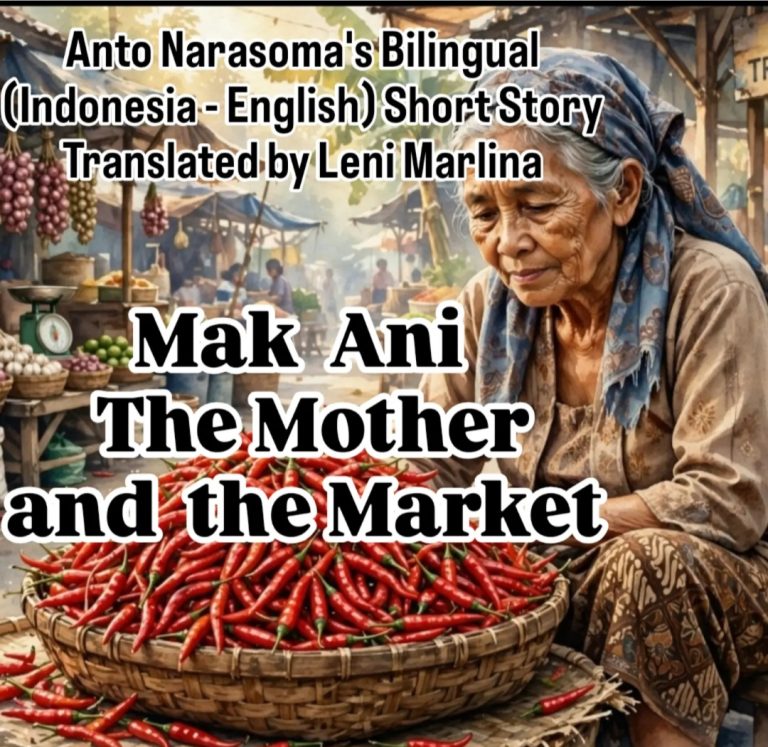
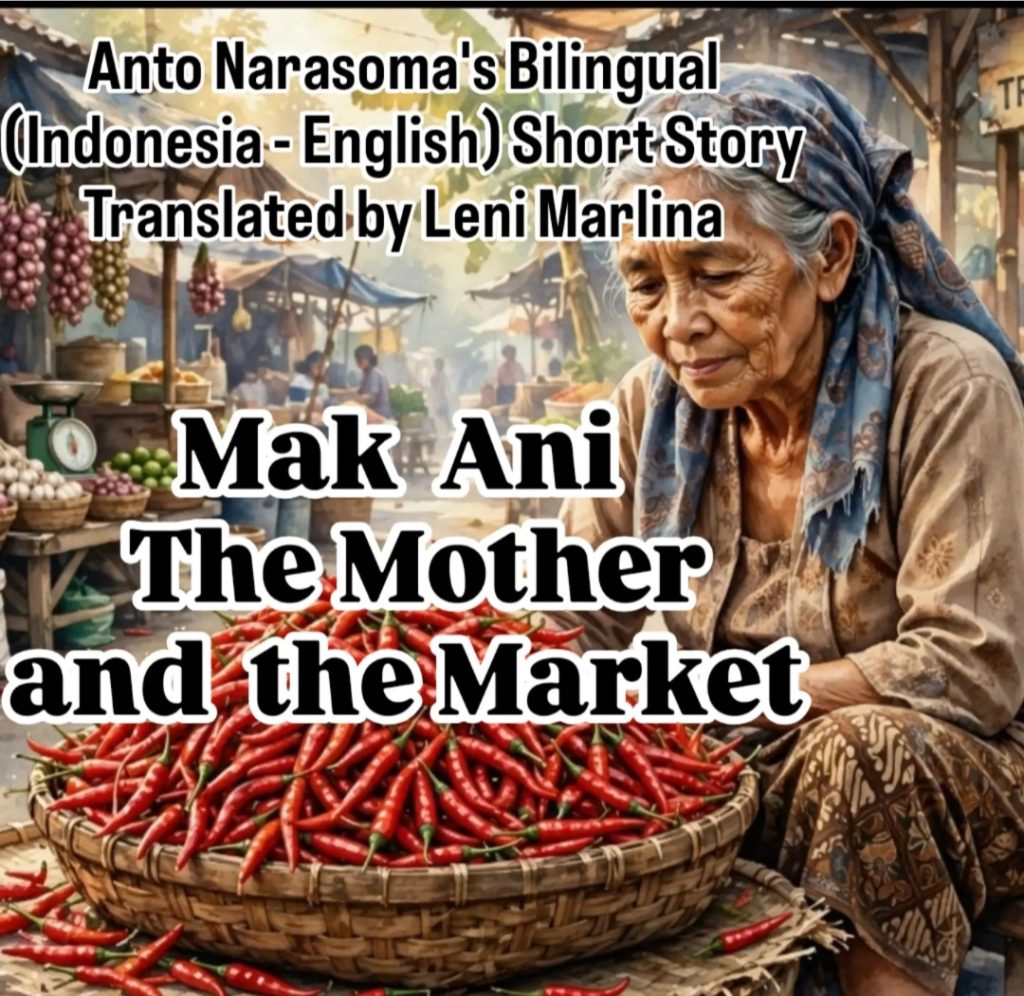
Mak Ani – The Mother in The Market
Short Story by Anto Narasoma
Baca juga: A Bilingual Poetry Collection by Wulandari - Translated by Leni Marlina: "THE LITTLE BOAT"
Translated (Indonesia – English) by Leni Marlina
–
Ten years earlier, after the death of her child, Mak Ani’s life had become a relentless struggle. Poverty had tightened its grip on her, and without a steady means of earning a living, she could barely provide for her most basic needs.
To keep herself alive, she tried to make a little money selling chillies and cooking spices discarded during sorting at the traditional market in her village.
The chillies, turmeric, and ginger she sold were leftovers from the sorting process at a wholesale market five kilometres away.
Every morning, Mak Ani walked the entire distance, a bamboo basket strapped to her back.
At the central market, she helped the workers sort through chillies and other spices, including turmeric and ginger. In return for her labour, they let her take whatever discarded produce was still good enough to use.
“Thank you, my dear. May I take these?” she would ask whenever they offered her the rejects.
She gathered the produce into her basket, carefully keeping whatever remained fit for sale. Then she would take her leave.
“I’ll be going now, everyone,” she said, before setting off for home with her modest collection.
The journey back to her village was long, and by midday the heat could be fierce. For Mak Ani, however, such hardships had become an ordinary part of life.
Even so, exhaustion showed on her face. Sweat drenched her body as she walked beneath the scorching sun.
She paid little heed to her weariness. She had to reach the village market in time to lay a sheet of plastic on the ground and arrange her chillies for sale.
The afternoon was sweltering. Sunlight blazed overhead, its scorching rays beating mercilessly against the skin.
Mak Ani reached the village market later than she had hoped. After walking five kilometres, her body was weary with exhaustion.
By then, only a small space at the far end of the market remained vacant. The spots nearer the main road had already been taken by other vendors.
“Ah, the only place left is right at the end, beside the rubbish dump. Never mind. Fortune, misfortune, and death are all in God’s hands. I’ll sell my goods here,” Mak Ani murmured to herself.
She spread a plastic sheet on the ground and arranged her wares. The chillies she had collected were divided into four small piles, each priced at five thousand rupiah.
Before long, a woman approached and asked about the price.
“How much for one pile of chillies, Mak Ani?” she asked.
Many people in the market knew Mak Ani. Her kind nature had made her familiar to the traders and regular customers, and her name was easily remembered.
“Only five thousand rupiah a pile, dear,” Mak Ani replied with a smile. “I don’t make much profit. You know, I walk all the way from the central market, five kilometres on foot. That’s why I don’t charge much.”
The woman was touched by the sight of Mak Ani’s deeply lined face, glistening with sweat.
“All right, Mak. I’ll take these two piles,” she said, holding out her money.
Mak Ani promptly gathered the two small piles of chillies into a black plastic bag and handed it to her customer.
“Thank you, dear.”
“You’re welcome, Mak,” the woman replied, then walked away.
The day was growing hotter. Mak Ani had long been accustomed to the sun’s relentless glare; years of working outdoors had darkened the skin of her arms.
She sold her little bundles of produce simply to meet her daily needs. There was no one else to provide for her, no family member she could depend on for a living.
Every day, she went to the central market to gather goods for resale. With no capital to buy merchandise, she helped the workers sort chillies, turmeric, ginger, and galangal.
She received no wages for her labour. What she received instead were the discarded chillies and spices that the workers allowed her to take home.
“Alhamdulillah,” she whispered. “Today, there is still some sustenance for me, something I can turn into a meal.”
She carefully put the ten-thousand-rupiah payment from her customer away. Then she cleared the space where the two piles had been and rearranged the remaining chillies into two neat piles, hoping someone else would buy them.
When she had finished, she sat behind a rubbish bin some distance from her stall.
Nearby stood a breadfruit tree heavy with fruit, offering a little shade from the punishing sun. Mak Ani rested beneath it, her eyes never straying far from her goods.
From the northern end of the market came three young men, their hands and faces covered in tattoos. They staggered as they walked, their movements betraying their drunkenness.
“Whose goods are these?” shouted the long-haired one.
His face was menacing, his expression utterly devoid of warmth.
Startled, Mak Ani hurried towards them. She looked at the three young men in fear, her body trembling.
“They’re mine, son. Is there something wrong?” she asked.
“We’ve come to collect protection money,” the first young man said sternly.
“Oh, son, I’ve only just set up my stall. I’ve sold only ten thousand rupiah’s worth so far. Could you wait a little longer?” Mak Ani pleaded.
“Pay now! If you don’t give us the protection money, I’ll smash your goods to pieces!” he shouted.
His voice was so harsh that people nearby turned to see what was happening.
Fear settled deep within Mak Ani. She knew how ruthless these thugs could be. Only the previous week, they had beaten a Javanese fried-noodle vendor whom they accused of refusing to pay their protection fee.
Ten thousand rupiah. That was all she had earned from selling two small piles of chillies—the very produce she had painstakingly gathered that morning, thanks to the kindness of the workers at the central market.
No. I will not give them this money.
She had risen early and walked five kilometres to collect those discarded chillies. Every coin she earned came from her own labour, from the hours she spent sorting produce and the miles she walked beneath the sun.
Oh, Allah, how cruel these thugs are, she thought bitterly.
Mat Rompal, the gang’s leader, grew angrier. His face hardened, and his behaviour became increasingly violent. He reached for the machete tucked into his waistband and drew it out.
Mak Ani did not run.
The market had become a second home to her. Over the years, she had grown attached to the people who worked and traded there. They, in turn, had come to regard her as an elder among them. To them, she was simply Mak Ani, the familiar old woman whose presence had become part of their everyday lives.
“My son, I can’t give you protection money yet. I’ve only just arrived,” she explained.
“I saw someone buy your chillies,” Mat Rompal replied sharply. “That means you’ve already made money. So pay us!”
His eyes were bloodshot, and he swayed on his feet. He was plainly drunk.
Without warning, he swung his machete at the small piles of chillies. His companions crowded around the stall and joined in, trampling the poor woman’s merchandise underfoot.
“Oh, Allah! How could you do this to me, Mat Rompal?” Mak Ani cried, tears streaming down her face. “How can you oppress a poor old woman like me? Have I not suffered enough?”
Her voice broke into a hoarse, sorrowful sob.
The sight of Mat Rompal and his gang abusing Mak Ani filled the people around them with anger.
“Hey, Mat Rompal! You can’t treat her like that!” someone shouted, unable to bear the injustice. “Mak Ani is an old woman struggling just to survive. If you want money, go and demand it from the big traders in this market!”
“What do you want?” Mat Rompal roared. “You want to defend Mak Ani? Come here, and I’ll chop your head off!”
At once, the thugs moved to attack the man.
But the surrounding traders rallied together. They rushed forward in solidarity, carrying whatever they could find to defend themselves: pieces of wood, stones, and other makeshift weapons.
Together, they descended upon Mat Rompal.
The heavily tattooed drunkard was soon overwhelmed. He collapsed onto the filthy, black mud, his body drenched in blood. His companions fled in haste, abandoning him where he lay.
But what of Mak Ani?
Before the market traders could unite against Mat Rompal and his gang, the old woman had already been struck by the slash of his machete.
She lay motionless in a corner beside the wall of the market’s rubbish enclosure.
Her eyes stared wide open. Blood covered her frail body, and in her thin, lifeless-looking hand she still clutched a black plastic bag containing the ten thousand rupiah she had earned from selling her chillies.
The money remained in her grasp. Not long afterwards, three police officers arrived at the scene.
–
Palembang, Indonesia, October 10th, 2026
–
Brief Information About the Writer – Anto Narasoma

Anto Narasoma is a respected national poet, writer, and senior journalist, stands as a guiding light in Indonesia’s literary scene. Known for his modesty and deep dedication, he has shaped generations of writers through mentorship and community leadership. In 2022, his lifelong contribution was recognized with a Literary Award from the Spanish International Literary Association, honoring both his poetic depth and quiet influence on global literary exchange.
—
Brief Information About the Translator – Leni Marlina

Leni Marlina is an Indonesian poet, writer, translator, and lecturer in the English Department, Faculty of Languages and Arts, at Universitas Negeri Padang, Indonesia since 2006. Her creative and scholarly work spans poetry, fiction, essays, literary criticism, review, translation, and literacy studies.
—-
Indonesian Version
MAK ANI
Cerpen: Anto Narasoma
–
Sejak sepuluh tahun lalu, setelah ditinggal mati anaknya, nasib Mak Ani benar-benar sulit. Ia sangat menderita karena tak ada mata pencarian yang dapat menyejahterakan hidupnya.
Dalam perjuangan hidup yang teramat berat itu, Mak Ani mencoba mengais rezeki lewat berjualan cabe dan bumbu-bumbu masakan sisa sortiran di emperan pasar rakyat di kampungnya.
Cabe, kunyit, dan jahe yang ia jual, diperoleh Mak Ani dari hasil sortiran pedagang besar di pasar induk yang berjarak lima kilometar dari kampungnya.
Setiap pagi, dengan berjalan kaki sejauh lima kilometer, Mak Ani membawa keranjang bambu di punggungnya.
Mak Ani selalu membantu pekerja yang berusaha menyortir cabe dan bumbu-bumbu rempah lainnya seperti kunyit dan jahe.
Dari sortiran itu Mak Ani disilahkan mengambil sisa-sisa cabe, kunyit, dan jahe yang masih bisa dimanfaatkan.
“Terima kasih, adik. Saya ambil ya?” tukas Mak Ani saat diberikan sisa barang sortiran tersebut.
Kemudian Mak Ani mewadahinya ke keranjang yang ia bawa. Lalu ia permisi dan membawa sisa barang sortiran yang masih bagus. “Saya pamit adik-adik,” kata Mak Ani. Ia pun berlalu dari sana.
Dalam perjalanan panjang kembali ke kampungnya, cuaca siang cukup panas. Bagi Mak Ani, hal-hal seperti itu sudah biasa saja.
Meski demikian, dari wajahnya kelihatan begitu lelah dengan keringat membasahi sekujur tubuhnya.
Walaupun begitu, Mak Ani tak ambil peduli. Pokoknya ia harus sampai tepat waktu ke pasar rakyat untuk menjual cabe secara menghampar di atas lapisan plastik.
Siang itu suasana cukup panas. Sorot cahaya matahari begitu mencorong menyengat kulit.
Mak Ani tiba di pasar rakyat kampung sudah agak kesiangan karena berjalan kaki sejauh lima kilometer. Uh, alangkah lelahnya fisik Mak Ani.
Kebetulan saat ia tiba di pasar rakyat, hanya tinggal ruang kecil paling ujung. Sementara ruang-ruang yang dekat jalan besar sudah ditempati pedagang lain.
“”Ah, saya di posisi paling ujung dekat pembuangan sampah. Tak apalah. Tapi balak, maut, dan rezeki ada di tangan Tuhan. Biar saya jualan di sini saja,” tukas Mas Ani seolah berbicara pada dirinya sendiri.
Ia meletakkan karung plastik di atas tanah dan menjajarkan dagangannya. Cabe yang ia himpun dibikin empat kelompok. Satu kelompok ia hargai sekitar Rp 5000.
Tak lama di antaranya seorang pembeli wanita datang dan menanyakan harga cabe yang tersusun rapi.
“Berapa seporsi cabe ini, Mak Ani?” tanya wanita itu. Mak Ani sudah banyak yang kenal dan diketahui pembeli. Mereka tahu sikap Mak Ani yang baik hati. Jadi orang begitu mudah mengingat nama Mak Ani.
“Seporsinya hanya lima ribu rupiah, Nak. Mak tak banyak mengambil untung. Tahu sendiri, Nak, mak jalan kaki dari pasar induk sejauh lima kilometer. Makanya mak tak banyak mencari untung,” jawab Mak Ani tersenyum.
Wajahnya yang penuh keriput dan becek keringat itu sangat menyentuh perasaan pembeli.
“Baik, Mak. Saya minta dua tumpuk ini saja,” tukas wanita itu seraya menyodorkan uangnya.
Mak Ani segera mewadahi dua tumpuk kecil cabe ke dalam kantong plastik hitam dan langsung memberikannya ke pembeli tersebut.
“Terima kasih, Nak,” ujar Mak Ani.
“Sama-sama, Mak,” jawab wanita itu dan segera berlaku dari situ.
Saat itu hari mulai siang. Cahaya matahari menyorot panas. Mak Ani sudah terbiasa dengan sengatan sinar matahari. Karena itu kulit lengannya terlihat hitam akibat terbakar matahari.
Ia berusaha jualan kecil-kecilan hanya untuk menutupi kebutuhan hidupnya. Karena tak ada orang atau keluarga lainnya yang akan menafkahi Mak Ani.
Ia mencari barang dagangan setiap hari ke pasar induk. Karena tak mempunyai modal berdagang, ia membantu para pekerja untuk menyortir cabe, kunyit, jahe dan lengkuas.
Walaupun Mak Ani tidak mendapat upah bayaran, tapi ia memperoleh sisa-sisa cabe sortiran dan sisa bumbu lainnya.
“Alhamdulillah. Hari ini masih ada rezeki yang bisa saya manfaatkan untuk mengatasi kebutuhan makan saya,” ucap Mak Ani segera memasukkan uang sepuluh ribuan dari pembeli tadi.
Ia segera membersihkan bekas dua tumpuk cabe tadi, dan mengatur dua tumpuk cabe yang belum laku untuk dijual kembali.
Setelah menyusun dua tumpuk cabe yang tampak menarik pembeli, Mak Ani duduk di belakang bak sampah yang agak jauh dari dagangannya.
Ia berlindung di bawah pohon sukun yang berbuah lebat tak jauh dari bak sampah. Mata orang tua itu tak lepas dari barang dagangannya.
Dari arah utara, ada tiga pemuda yang tangan dan wajah mereka penuh tato. Mereka jalan sempoyongan. Tampaknya kondisinya dalam keadaan mabuk.
“Ini dagangan siapa?” teriak pemuda berambut gondrong. Wajahnya terlihat seram dan tak terlihat adanya senyuman.
Mak Ani kaget. Ia segera datang dengan tergesa-gesa. Wajahnya terlihat takut menatap tiga pemuda.
“Ini dagangan saya, Nak. Ada apa, ya?” tukas Mak Ani dengan tubuh bergetar.
“Minta duit keamanan,” kata pemuda pertama dengan suara tegas.
“O, ibu baru saja meletakkan dagangan ini, Nak. Baru laku sepuluh ribu rupiah. Nanti saja, ya, sebentar lagi,” jelas Mak Ani.
“Bayar sekarang. Kalau tidak memberi uang keamanan, dagangan ibu akan saya hancurkan,” kata pemuda itu dengan nada keras, sehingga orang-orang di sekitar itu memandang ke arah mereka.
Ada rasa takut di dalam diri Mak Ani. Ia merasakan bagaimana kekejaman para preman itu. Karena pada minggu lalu, ia memukuli pedagang mie goreng Jawa yang dinilainya tidak membayar uang keamanan.
Apakah uang sepuluh ribu hasil penjualan dua _cumpuk_ (kelompok kecil) cabe yang ia peroleh dari hasil sortiran pemberian dari para sahabatnya di pasar induk.
Ah, uang ini tidak akan saya berikan kepada para preman tersebut. Sebab, cabe yang terjual itu ia peroleh setelah pagi-pagi sekali Mak Ani ke pasar induk.
Ya Allah, alangkah kejinya preman-preman ini, begitu bisik hati Mak Ani.
Mat Rompal yang menjadi pemimpin preman tersebut marah dan kelihatan mulai brutal. Ia mencabut golok yang terselip di pinggangnya.
Mak Ani tidak mau lari dari tempat itu. Sebab, ia merasa bahwa lokasi pasar tersebut sudah menjadi rumah kedua baginya.
Lagi pula Mak Ani merasa bahwa orang pasar sudah menjadikan dirinya sebagai orang tua. Mak Ani, sebutan akrab warga pasar.
“Nak, Emak belum bisa memberi uang jaga untuk kalian. Apalagi Emak baru sampai di pasar ini,” jelas Mak Ani.
“Saya lihat tadi dagangan Emak sudah laku. Makanya kami minta uang keamanan,” tukas Mat Rompal dengan suara tegas.
Matanya memerah memandang Mak Ani. Kelihatannya Mat Rompal ini mabuk berat. Ia berdiri agak sempoyongan.
Golok di tangannya itu ia sabetkan ke lima cabe tumpukan kecil. Bahkan anak buahnya segera mengerubungi dan menginjak-injak dagangan orang kecil.
“Yah Allah, alangkah teganya kau melakukan ini kepada Emak, Mat Rompal. Orang miskin seperti Emak masih kau tindas seperti ini,” Mak Ani mengucurkan air mata. Ia menangis sedih sekali. Suara tangisannya terdengar
parau.
Melihat Mak Ani diperlakukan kelompok Mat Rompal, mereka marah bukan main.
“Hei, Mat Rompal, jangan begitu caranya. Mak Ani itu wanita tua yang hidupnya sudah. Kalau mau minta duit, minta saja dengan pedagang besar di pasar ini,” teriak seseorang yang simpatik melihat Mak Ani diperlakukan tidak adil.
“Kau mau apa? Mau membela Mak Ani? Sini nanti aku penggal lehermu,” teriak Mat Rompal dengan suara marah..
Saat itu juga, para preman berusaha untuk menyerang orang tersebut. Tapi dengan kompaknya, para pedagang sekitar ikut menyerbu. Mereka membawa berbagai senjata. Ada yang membawa potongan kayu, batu, dan senjata seadanya
Mereka secara beramai-ramai mengeroyok Mat Rompal. Laki-laki pemabuk yang di tubuhnya banyak tato itu akhirnya terkulai mandi darah di tanah becek yang hitam dan busuk. Sedangkan anak-anak buahnya bergegas lari meninggalkan tempat itu.
Lalu bagaimana nasib Mak Ani? Ternyata, sebelum orang-orang pasar ikut mengeoroyok Mat Rompal, Mak Ani terkena sabetan golok Mat Rompal.
Wanita tua itu tergeletak diam di sudut dinding bak sampah pasar rakyat.
Matanya terbelalak, sedangkan tubuhnya mandi darah, dengan tangan kurusnya menggenggam plastik hitam tempat menyimpan uang Rp 10 ribu hasil jualan cabenya tadi. Tak lama di antaranya, tiga polisi tiba di tempat tersebut.
–
Palembang, 10 Oktober 2026
————
Informasi Singkat Mengenai Penulis – Anto Narasoma
Anto Narasoma adalah penyair nasional, penulis, dan wartawan senior terkemuka yang menjadi salah satu sosok penting dalam perkembangan sastra Indonesia. Dikenal karena kesederhanaan dan dedikasinya yang mendalam, ia telah membimbing banyak generasi penulis melalui pendampingan serta kiprahnya dalam komunitas sastra. Pada 2022, kontribusi panjangnya dalam dunia sastra mendapat pengakuan melalui Penghargaan Sastra dari Spanish International Literary Association, sebagai bentuk apresiasi atas kedalaman karya puisinya dan pengaruhnya yang bersahaja dalam memperkuat pertukaran sastra lintas negara.