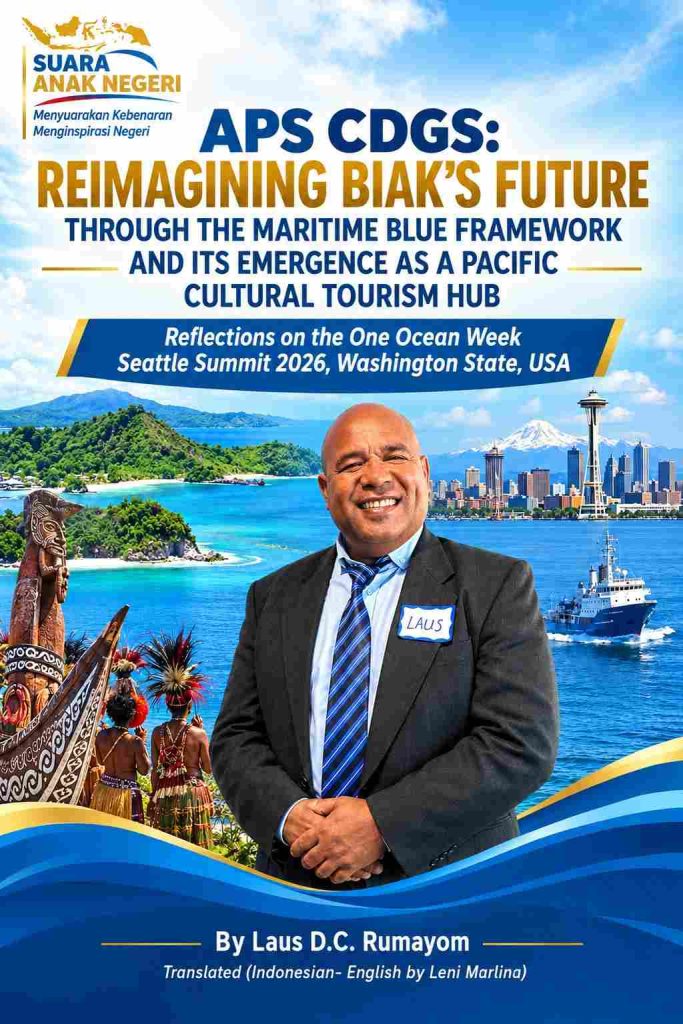
WASHINGTON – SUARA ANAK NEGERI| The ocean is far more than a geographical divide separating islands. It is a lifeline connecting civilisations, facilitating trade, enabling cultural exchange, and fostering cooperation among nations. Viewed through this broader perspective, Biak Numfor Regency in Papua, Indonesia, possesses considerable strategic potential to pursue a development model that places the ocean at the heart of economic prosperity and cultural identity.
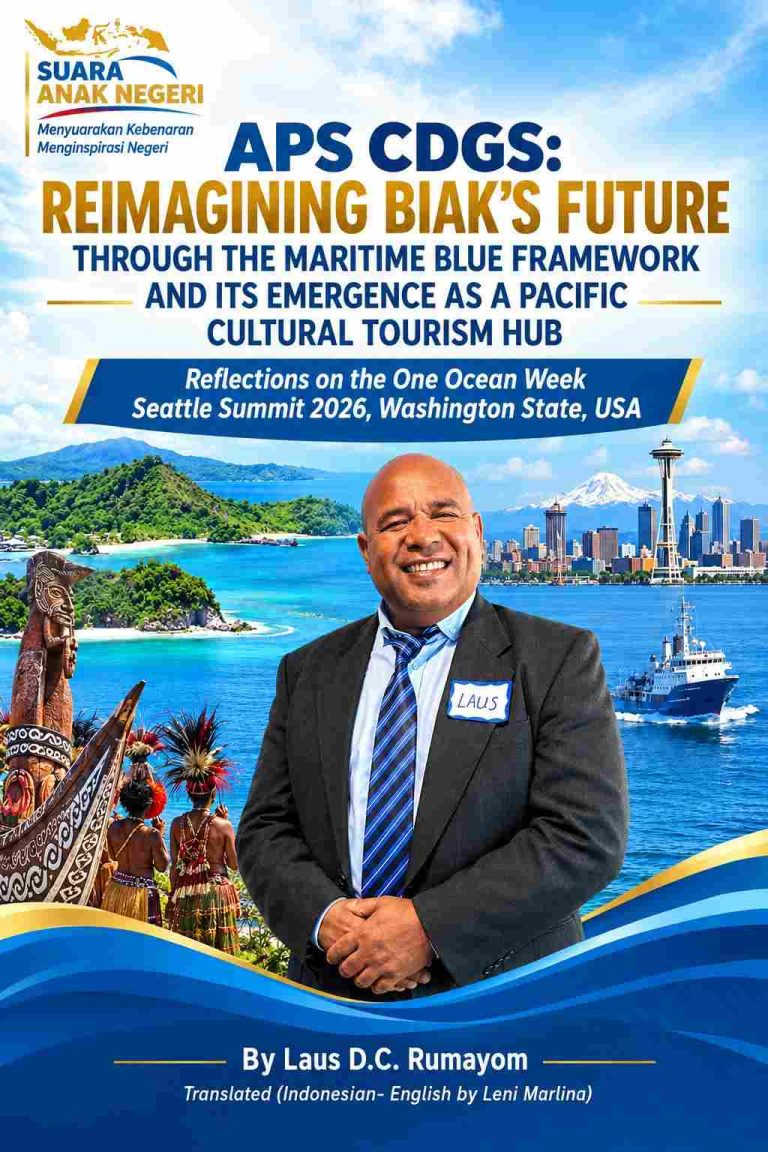
This vision takes on particular significance in the context of the One Ocean Week Seattle Summit 2026, held from 19 to 25 October 2026 at the Bell Harbor International Conference Center in Washington State, United States. Organised by Maritime Blue, the forum brings together maritime leaders, innovators, investors, policymakers, academics, artists, and coastal communities to advance a more sustainable and inclusive maritime future.
As founder and Chairman of Analisis Papua Strategis Center for Development and Global Studies (APS CDGS), and an academic specialising in International Relations at the Faculty of Social and Political Sciences, Cenderawasih University, I am participating in this international forum. The occasion provides an opportunity to bring Biak into the global dialogue on the blue economy, maritime innovation, and the development of culturally grounded tourism.
Baca juga: Ihwan Nugraha Hadirkan Horison Seseorang, Antologi Puisi dengan Metafora Lima Lapisan Atmosfer Bumi
For Biak, this is not simply an opportunity to showcase the region’s potential to an international audience. It is also a chance to rethink its development trajectory by bringing together its maritime history, ocean resources, cultural heritage, technological advancement, and the aspirations of its people.
The people of Biak possess a rich seafaring tradition that forms an important part of the history of inter-island connections across the Pacific and the Indonesian archipelago. According to APS CDGS documentation, the Biak people have been recognised as a maritime community by various peoples and nations since before the eighth century CE. Their seafaring activities reportedly expanded considerably between the fourteenth and eighteenth centuries, reaching areas including Maluku, Sulawesi, Java, Raja Ampat, the Malay Peninsula, Australia, and Madagascar.
This maritime heritage provides a historical foundation for revitalising Biak’s identity and future as a maritime region. Its seafaring past should not be confined to historical narratives or nostalgic recollections. Properly documented and developed, it can become a living source of knowledge, cultural identity, education, and sustainable economic opportunity.
Biak could bring this heritage to a wider audience through museums, cultural interpretation centres, Biak-Melanesian cultural festivals, the documentation of oral traditions, marine tourism, and collaborative research with universities. Visitors would then experience more than the region’s natural beauty: they would gain insight into traditional navigation, historical trading routes, relationships between communities, and cultural knowledge transmitted across generations.
Crucially, this approach must recognise Indigenous communities as the custodians of their heritage and the principal stakeholders in its development. Cultural preservation cannot be separated from respect for Indigenous rights, the protection of customary lands and marine territories, and the fair distribution of tourism revenue and other economic benefits.
The Maritime Blue approach offers a framework for maritime development that brings together innovation, environmental stewardship, investment, workforce development, and cross-sector collaboration. For Biak, its relevance lies in the opportunity to build an economy that generates prosperity without compromising the health of marine ecosystems or marginalising local communities.
First, the regional government should promote sustainable economic activities rooted in marine resources. Fisheries, seafood processing, maritime services, micro, small, and medium-sized enterprises (MSMEs), and marine tourism could form the foundations of a more diversified blue economy. Such development must be supported by responsible fisheries management, marine pollution prevention, coral reef conservation, and effective oversight of coastal resource use.
Second, maritime connectivity should be treated as a strategic development priority. Safe and efficient ports, reliable sea transport, dependable energy supplies, and streamlined logistics could strengthen Biak’s connections with other parts of Indonesia and facilitate its integration into regional Pacific tourism networks. However, infrastructure investment must be grounded in rigorous feasibility assessments, local needs, financial sustainability, and robust environmental safeguards.
Third, investment in human capital must remain central to the development agenda. Vocational education, maritime safety training, tourism management, digital marketing, foreign-language proficiency, and entrepreneurship programmes can equip Biak’s younger generation with the skills needed to participate in an evolving maritime economy.
Development cannot be considered transformative if the most significant employment opportunities and investment benefits accrue primarily to workers and businesses from outside the region. Local people must be equipped not merely to participate in economic change, but to shape it, lead it, and benefit from it.
Positioning Biak as a Pacific Cultural Tourism Hub
The ambition to establish Biak as a hub for maritime and cultural tourism in the Pacific should be understood as a long-term strategic vision, rather than an outcome that can be achieved through destination marketing alone. Its realisation will depend on reliable connectivity, high-quality tourism services, a distinctive cultural identity, effective governance, and enduring international partnerships.
Biak has the potential to develop integrated tourism experiences that combine marine attractions, seafaring history, performing arts, local cuisine, traditional crafts, and meaningful encounters with local communities. Cultural festivals could serve as gateways through which international visitors, researchers, creative professionals, and cultural organisations discover the region’s distinctive heritage.
For this vision to deliver lasting benefits, local communities must have meaningful opportunities to own, manage, and participate in tourism enterprises. Indigenous communities, artists, young people, fishers, small-business owners, and creative economy practitioners should be involved from the earliest stages of planning.
The regional government can support these efforts through professional training, service-quality standards, digital marketing initiatives, access to financing, and partnerships with travel operators, universities, and cultural institutions.
Environmental sustainability must be equally fundamental. Biak’s coastal landscapes, marine biodiversity, and surrounding ecosystems are among its most valuable assets. They must not be sacrificed in pursuit of short-term increases in visitor numbers. Tourism infrastructure should therefore be developed alongside effective waste management, pollution control, the protection of ecologically sensitive areas, and systematic monitoring of tourism’s environmental impacts.
At its best, Biak’s emergence as a Pacific cultural tourism hub would create a space for intercultural dialogue, strengthen relationships among Pacific communities, and generate economic opportunities without diminishing the integrity of local traditions.
The document Fueling the Future: Sustainable Maritime Fuel Policy Feedback Guide, referenced in APS CDGS materials, offers further insights into the transition towards cleaner maritime transport. It highlights the importance of aligning vessel technologies, port infrastructure, sustainable fuel availability, financing mechanisms, regulatory frameworks, and workforce development.
These considerations are particularly relevant to Biak as maritime connectivity and tourism expand. A practical starting point would be to assess energy consumption and emissions at port facilities and along prospective shipping routes.
Short-distance vessels operating on regular schedules could be evaluated for the feasibility of electric or hybrid propulsion, subject to technical requirements and operating conditions. For longer-distance voyages, the appropriate technologies would need to be determined by economic viability, safety considerations, operational demands, and the availability of suitable energy sources.
Shore power, enabling vessels to connect to land-based electricity supplies while berthed, could also be considered at ports with sufficient electrical grid capacity. Where technically and economically viable, this approach could reduce the need to operate diesel generators while vessels remain at the quay.
Nevertheless, such investments should be introduced progressively, following comprehensive assessments of demand, costs, infrastructure readiness, and environmental benefits. Technological modernisation should be guided by local circumstances rather than imposed as a one-size-fits-all solution.
Equally important is the principle of a just maritime transition. Small-scale fishers, local vessel operators, port workers, and coastal communities must not be left to bear the financial and social costs of technological change. Appropriate support, skills development, and access to new economic opportunities are essential to ensuring that the transition benefits society as a whole.
Ultimately, the success of maritime development should be measured not simply by investment volumes or technological advances, but by cleaner coastal environments, decent employment, higher local incomes, and a fairer distribution of economic benefits.
APS CDGS can play a constructive role in translating this vision into an actionable development agenda by connecting academic research, government policy, Indigenous communities, the private sector, and international partners.
Its contribution could include strategic studies on maritime development in Biak, assessments of cultural tourism potential, research into Pacific connectivity, and evidence-based policy dialogues designed to inform regional planning and investment decisions.
Several initial priorities merit consideration: developing a strategic roadmap for Biak as a Pacific maritime cultural tourism hub; initiating pilot projects for environmentally responsible port operations; strengthening maritime education and vocational training; and establishing collaborative networks with universities and international maritime organisations.
Each initiative should be accompanied by measurable performance indicators. These might include the number of local enterprises involved, the number of people trained, changes in household and community incomes, improvements in coastal environmental quality, and the proportion of economic value retained within Biak.
Such indicators would help ensure that the vision does not remain confined to conference discussions or policy declarations, but develops into practical programmes whose outcomes can be independently assessed.
International engagement must also be approached with realism. Participation in global forums creates opportunities to exchange expertise, establish relationships, and explore potential partnerships. It does not, by itself, guarantee investment, funding, or the implementation of specific programmes.
The real test lies in the quality of the follow-up: credible project proposals, sound technical assessments, meaningful community participation, and sustained government commitment. Without these elements, international engagement risks remaining symbolic rather than delivering tangible benefits.
Transforming Biak’s development through the Maritime Blue framework and Pacific cultural tourism offers an opportunity to connect historical identity, environmental stewardship, economic advancement, and the aspirations of future generations.
The seafaring heritage of the Biak people provides a distinctive cultural foundation, while the blue economy offers a pathway towards a more innovative, productive, and environmentally responsible future.
The One Ocean Week Seattle Summit 2026 provides a valuable platform for broadening perspectives, exchanging knowledge, and exploring international cooperation. Yet the ultimate measure of its significance will not be participation in a prestigious global forum. It will be whether the knowledge gained and relationships established can be translated into practical initiatives that respond to the needs and priorities of Biak’s people.
Biak need not choose between economic progress and cultural preservation, nor between stronger maritime connectivity and the protection of the ocean. These objectives can advance together when development is carefully planned, Indigenous communities are meaningfully involved, local capabilities are strengthened, and marine ecosystems are protected for generations to come.
Ultimately, Biak’s emergence as a Pacific cultural tourism hub will depend on more than its geographical position. It will rest on the region’s ability to revitalise its maritime heritage, sustain its cultural traditions, and create lasting prosperity from a healthy ocean.
This is the transformative vision worth pursuing: an understanding of the sea not merely as a route for ships and commerce, but as a foundation of life, a meeting ground for nations and cultures, and a source of dignity, opportunity, and sustainable prosperity for the people of Biak.
—
About the Author
Laus D.C. Rumayom is the founder and Chairman of Analisis Papua Strategis Center for Development and Global Studies (APS CDGS) and an academic specialising in International Relations at the Faculty of Social and Political Sciences (FISIP), Cenderawasih University.