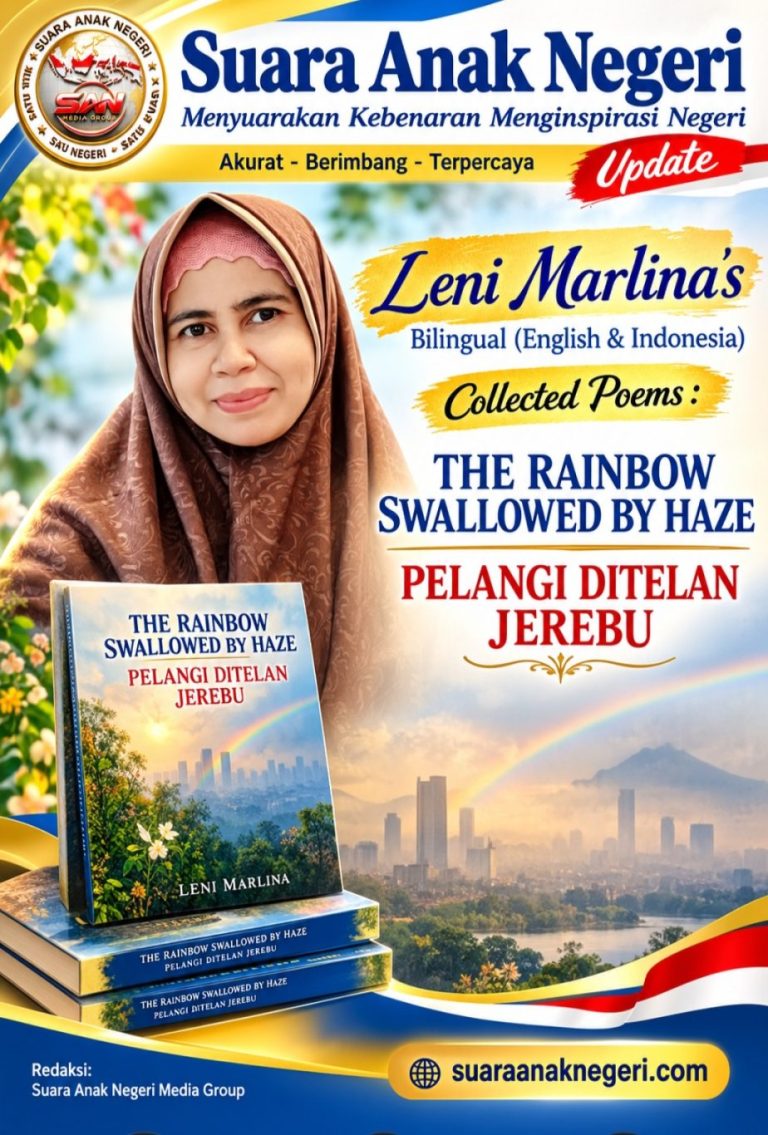
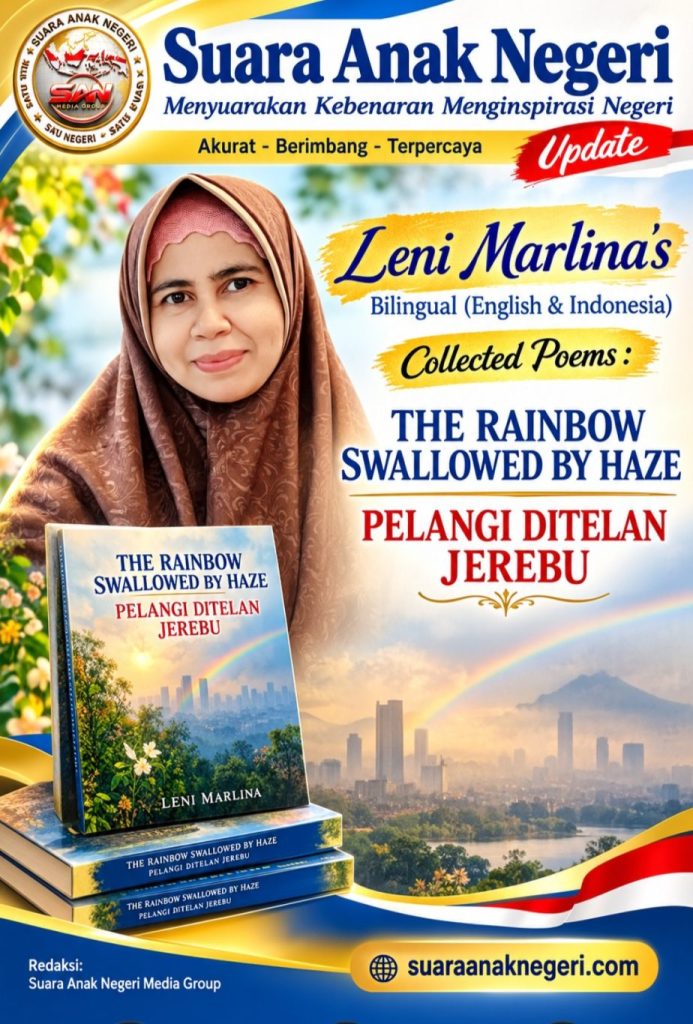
Leni Marlina’s Bilingual (English & Bahasa Indonesia) Collected Poems : “THE RAINBOW SWALLOWED BY HAZE”
/1/
THE RAINBOW SWALLOWED BY HAZE
Baca juga: SANG KAMASAN SOWEK
Poem by Leni Marlina
–
You arrive when the forest has lost its hum,
insects fold their wings beneath the sullen ash;
the sky seeps light through bewildered pores,
seven colours are born
yet the earth holds its breath.
Baca juga: Sastra Hidup Lagi Di Senen: 70 Pelajar Jakarta Pusat Ambil Estafet dalam Festival Komunitas 2026
You arch above a fevered city,
a fragile spectrum drawn from the womb of a darkened cloud;
colours pulse between windows and graves,
as though light were searching for the body it had lost.
Then the haze rises from the blackened earth,
slowly, almost without a sound;
leaf ash drifts into the sky,
becoming something like a grave,
while roots lose their bearings in the depths below.
It touches your red,
and red turns to ember,
your orange is gnawed away until it can scarcely breathe;
yellow trembles against the city windows,
almost speaking,
while green shelters the last forest behind the eyes.
Green lingers longest upon your fragile body,
one last grain of chlorophyll refuses to die;
it hides within your eyes,
a faint, stubborn pulse,
while the map folds the forest out of existence.
The haze is in no hurry.
It has the patience of something ancient,
slipping between the colours,
turning light into a wound;
blurring distance,
smudging names and air,
until even your name becomes a measure of visibility.
Below you,
trucks haul earth stripped of roots,
hills are pared away, one slow cut at a time,
then carried elsewhere;
above you,
birds veer off before they can ask:
who owns the sky, and who gets paid for it?
You are still smiling at the edge of a strange dusk,
or perhaps the light has forgotten how to turn away;
your face still holds a translucent glow,
while smoke writes its name
inside silent lungs.
Dusk strips the last colours from you,
chewing the spectrum down to bitterness;
red becomes dust,
green becomes a secret,
and the sky takes back
what it once gave.
You are still there:
a stray chromosome of light misplaced in the season,
cast into lungs breathing ever more foreign air;
a shard of prism with one clear edge gone,
turning cold,
while the colour we called for
never returns on the wind.
It answers with a cough
moving from house to house each morning;
windows close, guarding breath behind their silence,
while the forest keeps sending something
we have never learned to name.
And when night finally gathers every colour,
we cannot tell
whether you have vanished
or entered so deeply into us
that the haze has begun to find
your seven colours
running through our blood.
—
Padang, West Sumatra, Indonesia, September 2026
—-
/2/
AS SHARP AS YOUR GAZE
Poem by Leni Marlina
—
As sharp as your gaze, salt forgets the sea,
the hills keep their pulse beneath a weathered skin;
mist grazes a wound not yet given a name,
while roots count the soil slipping away.
You look at me in silence, but your gaze cuts deep,
like earth sensing the blade before the hoe goes in;
no cry rises from the shadowed valley,
only one hill missing from the landscape.
Beneath the map, the river shifts its veins,
a red line creeping outward, binding everything;
the earth’s pulse is reduced to coordinates,
and the forest becomes another number in a ledger.
Morning bites into the hills with iron jaws,
stone is torn from bone, glints once, then disappears;
its shine enters the books, dust settles in the pores,
and the mountain becomes tonnage before it can say, “I am here!”
Truck after truck carries away the slopes and seasons,
hauling the colours of soil, hauling what little memory remains;
a house is reduced to an address, the river loses its clarity,
and home becomes a destination no one can quite return to.
In the warehouse, minerals shed their names,
becoming grade, tonnage, price;
what once gleamed quietly in the earth’s deep womb
now flashes across distant screens, far from springs and prayers.
In the village, muddy water settles in jars,
children wait for fish that never return;
diesel seeps into the river, dark and slow,
teaching the water the language of loss.
Yet you look at me like rain arriving too late,
as though your hands have never known the weight of anything;
while the mountain is cut down, piece by piece,
lifted into the belly of a factory
until nothing remains that can still be called near.
At the roadside, a sign stands without apology:
“PRODUCTION AREA”:
two words, one hammer;
wings, roots, moss, nests, and silence
all suddenly reduced to numbers and speed.
Birds leave; branches hold what little remains,
seasons lose their calendars, fog its name;
the forest does not fall all at once,
it dwindles slowly, like breath borrowed for too long.
You hold my hand, warm enough,
but your palm conceals something darker:
a parcel of earth stamped with a number;
before it could acquire a name,
it had already become a secret.
As gentle as your gaze, the hill remains in my eyes,
though roots have been assigned boundaries, rivers their limits;
stone not yet born from the earth’s deep womb
already has its price.
Machines start; the night trembles between the cliffs,
the river narrows,
a vein growing stranger by the hour;
the earth’s sentence is cut short before it can be read,
and silence takes the place of language.
The last leaf drifts against our faces,
our reflections meeting briefly upon the wounded water;
one ripple erases the distance between us,
one hand still holding,
whether love,
or something else.
I almost ask: who are we trying to save?
But “save” sounds too pure
on ground like this;
so I let the question fall with the rain,
where it becomes something we never quite finish saying.
We are silent.
And when your hand slowly opens,
there is no root, no wound, nothing
only a thin red line circling our palms,
a boundary, perhaps, a price,
or something that has believed from the beginning
that our bodies
were simply another piece of land
waiting to disappear from the map.
—
Padang, West Sumatra, Indonesia, September 2026
—
/3/
YOU HAVE GONE
Poem by Leni Marlina
—
I knew you were gone
long before the classroom door learned to close;
what remained was not your footsteps,
but time caught in a rusted hinge
still pulsing
whenever I try to forget.
I no longer trust the clock very much.
It is too good
at making absence
look like a journey.
Outside the window,
a rainbow tries to take shape
between roof and sky,
but the haze comes
with its grey mouth
and swallows the colours
before evening can have them.
Perhaps that is longing:
something reaching for colour
when the air
is no longer clear
enough to receive it.
I do not call for you.
I open the window
and let your name
drift into the air.
Colour
as though it had lungs.
Red holds back a cough.
Yellow fades behind the mist.
Green trembles on the leaves.
Blue settles
where the eyes
can no longer reach.
Jealousy arrives without a sound.
It only moves a chair
a little closer to the window,
then waits in silence
to see who will be the first
to admit what they have seen.
I do not ask where you have been.
I notice a grain of dust upon your shoulder,
how somehow it knows the road
I never took.
Perhaps happiness
is only a pane of glass
that, for one brief moment,
stops asking
who stands before it.
The rainbow is swallowed by haze.
Yet somehow
I can still see traces of its colours
between our breaths.
Do not speak to me of fidelity.
The word is too slippery
for hands that tremble when they choose.
There is something in me
that has always wanted to be a door:
opened and closed by you,
then secretly hoping
you will forget the key.
But night
is never completely dark
when the sky still holds
the colours it failed to bring forth.
I look down at my feet.
Two shadows lie across the floor.
One is mine.
The other seems ready to leave,
yet something in the air
keeps it there.
Then you say my name so softly
the clock on the wall seems
to lose a second.
I turn.
No one is there.
Only seven colours
sliding slowly down the glass
onto the windowsill.
Morning begins to stir. A moth
settles there,
and suddenly
one of the colours catches on its wings.
It flies.
I do not know
whether it carries the rainbow,
or carries away something
that was meant
to stay here.
—
Padang, West Sumatra, Indonesia, September 2026
—–
About the Poet – Leni Marlina
Leni Marlina is an Indonesian writer, poet, lecturer, from West Sumatra, Indonesia, where she resides in Padang. Her passion for literacy and creative writing began during her school years and has remained a guiding thread throughout her life. Her engagement with literature deepened while she pursued a Master of Arts in Writing and Literature in Australia.
The poems and nursery rhymes in this collection have a special place in her literary journey. They were first written in 2011, when Leni was taking a Children’s Literature course during her master’s studies. More than a decade later, she revisited these early works, reimagining and refining them with a deeper understanding of childhood, imagination, language, and the natural world. The poems and nursery rhymes were published for the first time in 2026.
Since 2006, Leni has served as a lecturer in the Department of English Language and Literature, Faculty of Languages and Arts, Universitas Negeri Padang, Indonesia. Alongside her academic work, she writes poetry, short fiction, essays, and scholarly articles, and takes part in translation, literary, and editorial projects.
For Leni, writing is more than a creative practice. It is a way of listening to life, learning from the world, nurturing humanity, and sharing hope. This belief has encouraged her to participate actively in literary and literacy communities and to contribute to educational and creative spaces that connect people through language and literature.
She has been involved in communities and international literary networks including PPIC (Poetry-Pen International Community), WCLC (World Children’s Literature Community), ACC SHILA (ACC Shanghai Huifeng International Literary Community), Littalk-C (Literary Talk Community), and Starcom Indonesia (Starmoonsun Edupreneur Community).
Through her writing, teaching, and literacy initiatives, Leni seeks to make a meaningful contribution—however modest—to the cultivation of reading, writing, imagination, and literary appreciation. Over the years, she has received a number of local, national, and international literary recognitions. She regards these achievements not as destinations, but as milestones in an ongoing journey of learning, creativity, and service through literature. Email: lenimarlina@fbs.unp.ac.id
Wattpad: @lenimarlina_write
Instagram: @lenimarlina_starmoonsun
—
The Indonesian version of the poems abova are available in the official link below:
Kumpulan Puisi Karya Leni Marlina: “PELANGI YANG DITELAN JEREBU”