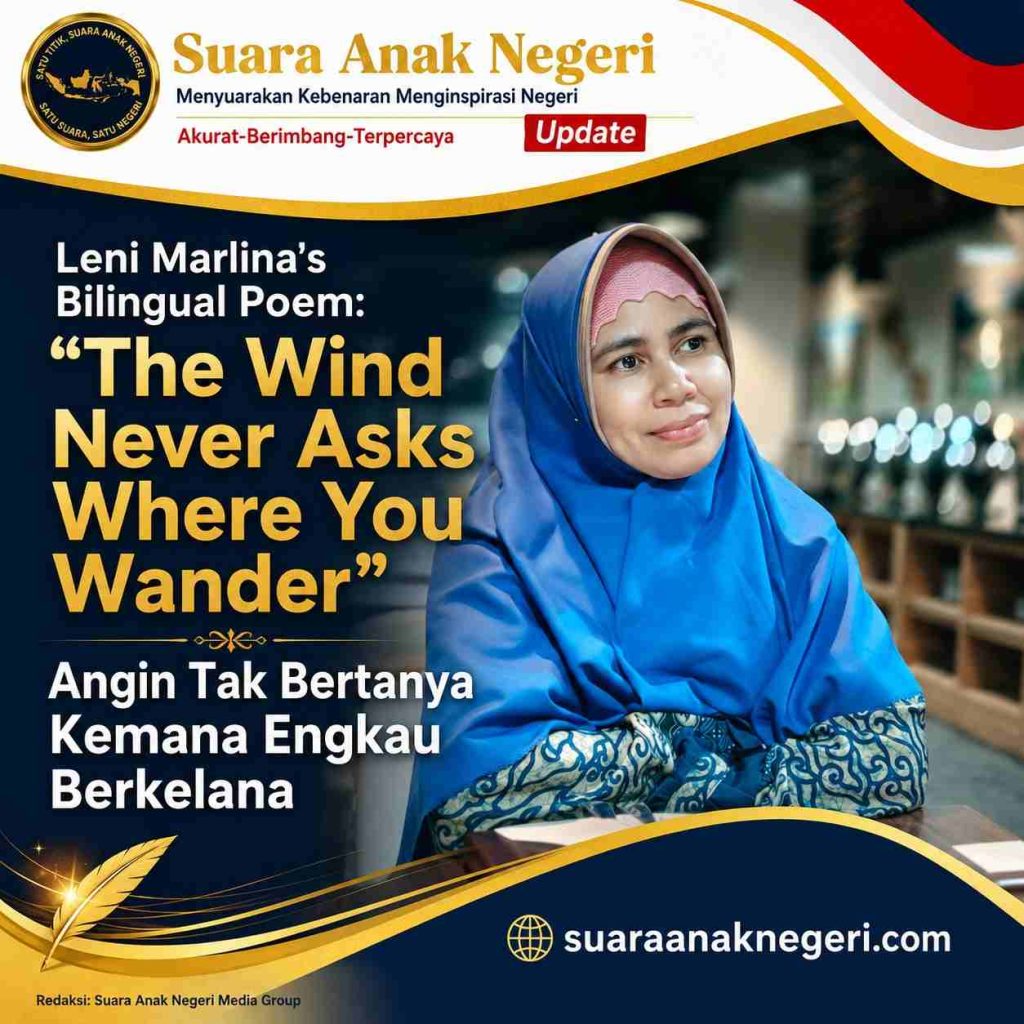
The Wind Never Asks Where You Wander
Poem by Leni Marlina
–
Baca juga: AKU KEHILANGAN ANAKKU KETIKA HUTAN TERBAKAR
The wind has neither house nor address;
it is born of distance, raised by getting lost,
touching leaves without waiting for a sign,
then leaving before the world can bind it to anything.
You, too, departed while the door was still open,
leaving a cup of silence upon the table;
no farewell had finished forming on your tongue,
no hand had reached in time to hold your departing shoulder.
Along the road, dust came to know your feet,
stones kept the heat of your soles;
you walked with the voices of the past,
sometimes heavier than the body carrying them.
Baca juga: Robert Frost’s Poems Translated (English – Indonesia) by Leni Marlina
At dusk, red light gathered along the city’s lip,
kitchen smoke drifted slowly back into the air;
you caught the scent of rice from a house that was not yours,
and suddenly your longing found a voice.
The wind never asked why you left,
never counted the doors you passed;
it only breathed across the footprints in the yard,
as though even loss were permitted to become a road.
Night threaded cold needles through your skin,
between bones that had begun to feel foreign;
you searched the silent sky for a direction,
but the stars remained distant, offering no instruction.
Then you understood: direction is not a sign,
nor a straight line laid down by the universe;
sometimes it grows from an opened wound,
like a root searching for water beneath an ancient stone.
You once believed that home meant returning
to the same door, the same chair, the same morning;
but a home can alter its shape inside you
while the address remains standing, unable to recognize you.
Some things you left behind became dust.
Some you carried without knowing why.
There are names that vanished from the edge of your tongue,
yet every night they knock softly from within.
The wind slips through the ribs of the windows,
making the curtains tremble as though they might speak;
it carries no message from anyone
only reveals how even silence can change its direction.
So do not ask the road
why it carried you toward the crossroads;
the road has never promised a destination.
It merely leaves a space open for possibility.
Do not curse the darkness when it comes,
for night has never owed you light;
it only veils what was too plainly exposed,
so your eyes may learn another way of seeing.
And if one day you lose your name,
do not hurry to find it in an old mirror;
perhaps that name is loosening itself from age,
making room for something truer to grow without a sound.
The wind never asks where you wander,
for the wind knows that direction is not always the point;
what matters is that your body can still open its wounds,
and your soul can still receive the horizon.
Walk—not because a destination waits,
not because someone is calling your name;
walk because the step is still yours,
before time takes it quietly from your body.
One day, when your hair is crowded with seasons
and your feet no longer recognize unfamiliar roads,
perhaps you will understand, in a silence clear as water:
what you have searched for all your life
was never a harbor,
but the courage
to remain without knowing
where the wind is carrying your body.
And when the wind returns through that night,
do not hold it; do not chase it with longing.
Let it touch your face, then pass.
Perhaps this is how life remembers you:
what is truly free
does not need to explain
where it has wandered.
–
Melbourne, Australia, 2013
About — Leni Marlina
Leni Marlina is an Indonesian poet, writer, translator, and lecturer in the English Department, Faculty of Languages and Arts, at Universitas Negeri Padang, Indonesia since 2006. Her creative and scholarly work spans poetry, fiction, essays, literary criticism, review, translation, and literacy studies. Alongside her academic career, she is actively involved in literary journalism and literacy advocacy. She serves as a writer, contributor, editor, and editorial board member for SAN Digital Media Group—including Suara Anak Negeri News, Suara Anak Negeri, and Negeri News—where she publishes literary works, essays, articles, and reports on education, literature, culture, and humanitarian issues. Marlina is also the founder and chairperson of several international literary and literacy communities, including PPIPM-Indonesia, Poetry Pen International Community (PPIC), Littalk-C Literary Talk Community, Translation Practice Community (Trans-PC), and the World Children’s Literature Community (WCLC). She is also an active member of several professional writers organizations, including SatuPena West Sumatra and PLS. Since 2012 she has been affiliated with the Victorian Writers Centre in Australia, and since 2024 has also been a member of the Shanghai Huifeng International Literary Association (ACC SHILA).
——
Indonesian Version:
Angin Tak Bertanya Kemana Engkau Berkelana
Puisi: Leni Marlina
–
Angin tak punya rumah, tak punya alamat,
ia lahir dari jarak, tumbuh dari sesat;
menyentuh daun tanpa pernah meminta isyarat,
lalu pergi ketika dunia belum sempat mengikat.
Kau pun berangkat ketika pintu masih terbuka,
meninggalkan secangkir sunyi di meja;
tak ada salam yang selesai kau eja,
tak ada tangan sempat menahan bahu yang pergi jauh ke sana.
Di jalan, debu mengenali kakimu,
batu menyimpan panas dari telapakmu;
kau berjalan membawa suara masa lalu,
yang kadang lebih berat daripada tubuhmu.
Senja menggulung merah di bibir kota,
asap dapur pulang perlahan ke udara;
kau mencium bau nasi dari rumah entah siapa,
dan tiba-tiba rindumu mempunyai suara.
Angin tak bertanya mengapa kau meninggalkan,
tak menghitung berapa pintu yang kau lewatkan;
ia hanya meniup bekas langkah di halaman,
seolah kehilangan pun boleh menjadi jalan.
Malam memasang jarum-jarum dingin,
di antara tulangmu yang mulai asing;
kau mencari arah pada langit yang hening,
tetapi bintang hanya berjarak, tak membimbing.
Lalu kau mengerti: arah bukan tanda,
bukan garis lurus yang disediakan semesta;
kadang ia tumbuh dari luka yang terbuka,
seperti akar mencari air di bawah batu tua.
Kau pernah mengira pulang berarti kembali,
ke pintu yang sama, ke kursi yang sama, ke pagi;
padahal rumah dapat berubah di dalam diri,
sementara alamat tetap berdiri tanpa mengenali.
Ada yang kau tinggalkan menjadi debu,
ada yang kau bawa tanpa tahu mengapa begitu;
ada nama yang hilang dari ujung bibirmu,
namun setiap malam mengetuk dari dalam kalbu.
Angin lewat di antara tulang-tulang jendela,
membuat tirai bergerak seperti ingin bicara;
ia tidak membawa pesan dari siapa-siapa,
hanya memperlihatkan: yang diam pun dapat berpindah arah.
Maka jangan tanyakan kepada jalan
mengapa ia membawamu ke persimpangan;
jalan tidak pernah berjanji tentang tujuan,
ia hanya menyediakan ruang bagi kemungkinan.
Jangan pula marahi gelap yang datang,
sebab malam tidak pernah berutang terang;
ia hanya menutup apa yang terlalu gamblang,
agar mata belajar melihat dengan cara yang lain.
Jika suatu hari kau kehilangan nama,
jangan buru-buru mencarinya di cermin lama;
barangkali nama itu sedang luruh bersama usia,
agar sesuatu yang lebih jujur tumbuh tanpa suara.
Angin tak bertanya ke mana kau berkelana,
sebab angin tahu: arah bukan selalu perkara;
yang penting tubuhmu masih sanggup membuka luka,
dan jiwamu menikmati cakrawala.
Berjalanlah, bukan karena tujuan menunggu,
bukan karena seseorang memanggil namamu;
berjalanlah sebab langkah masih milikmu,
sebelum waktu mengambilnya dari tubuhmu.
Kelak, ketika rambutmu penuh musim,
dan kakimu tak lagi akrab dengan jalan yang asing,
mungkin kau baru sadar dalam diam yang bening:
yang kau cari sepanjang hidup bukanlah tempat berlabuh,
melainkan keberanian
untuk tidak selalu tahu
ke mana angin membawa tubuhmu.
Dan bila angin kembali lewat malam itu,
jangan tahan, jangan pula mengejarnya dengan rindu;
biarkan ia menyentuh wajahmu, lalu berlalu,
sebab barangkali begitulah hidup mengingatkanmu:
yang benar-benar bebas
tak perlu menjelaskan
ke mana ia berkelana.
–
Melbourne, Australia, 2013
——