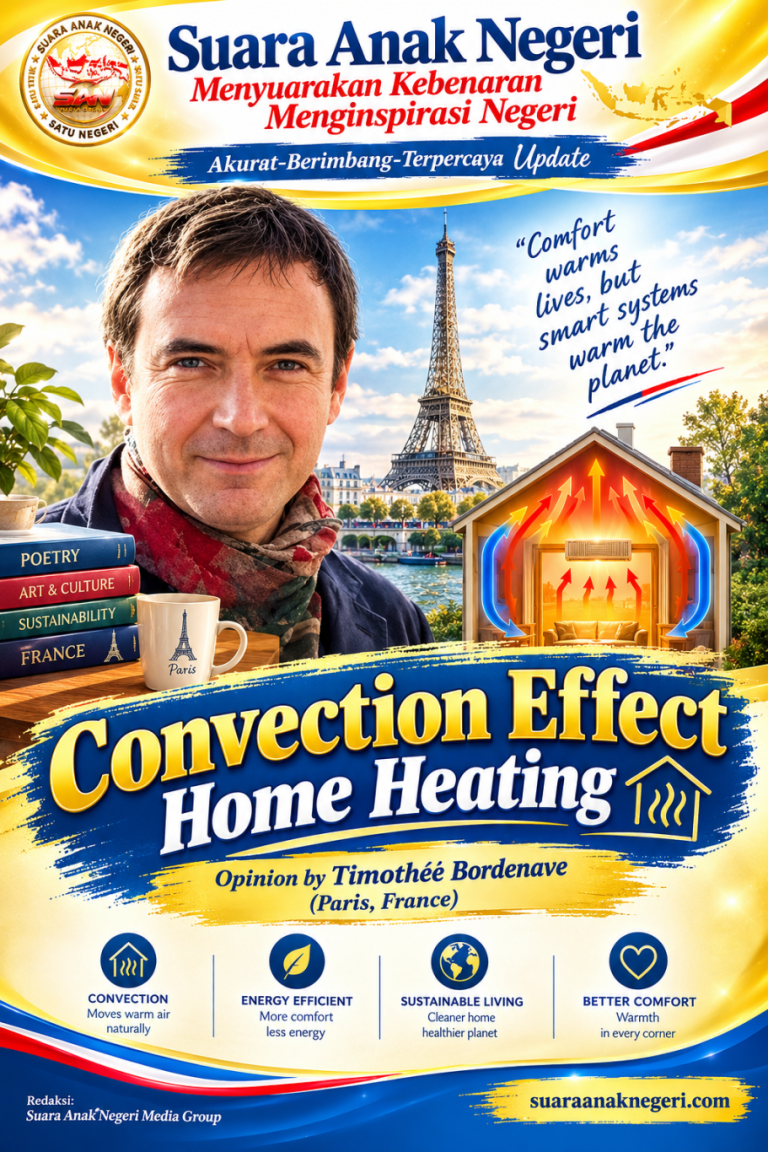
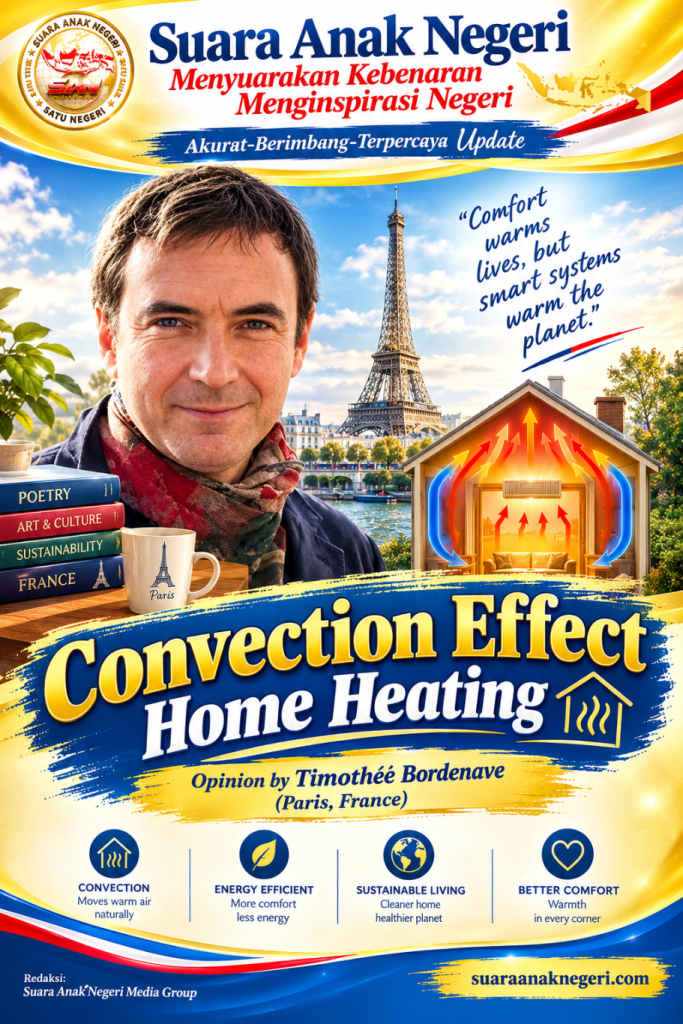
Convection Effect – Home Heating
Opinion by Timothee Bordenave
(Paris, France)
–
Baca juga: BETULKAH PBB MINTA INDONESIA MUNDUR DARI BOARD OF PEACE? INI PERSOALAN SEBENARNYA
Hello, dear friends. I wanted to present an idea related to home heating solutions, using the convection effect to improve the heating capacity of a device.
My thinking here stems from an observation I made: by using a steady flame, typically a tea light candle, which I placed on a saucer under an inverted terracotta pot with a hole in its center, and this pot raised slightly off the ground by wedges placed around its circumference, and then placing a larger pot on top of this first one, positioned in the same way, inverted, with a hole in the center, and raised slightly off the ground, and by extending a short metal wire through the hole in the first pot, which I had attached to its inner and outer sides, I found myself equipped with a very simple heating device. The flame from the candle, lit in the center on its saucer, heated the first pot and then the second, and the air circulated between them, thus heating an entire room like a radiator. All this, of course, at a very low cost.
I have tested this device often in various locations! You probably don’t know this, but before I thankfully to the Lord, found better Fortune, I often faced situations of poverty. That’s why I needed to heat my home without relying on electricity, or wood, which is scarce and expensive in urban areas. I used a candle and two terracotta flowerpots.
Baca juga: PLTN DI BATAM: ANTARA AMBISI ENERGI, RISIKO NUKLIR, DAN SENSITIVITAS SINGAPURA
This reflection goes even further today than this simple candle-based heating device. In my opinion, if you surround a heated surface with a material of the same type that has a comparable surface area, leaving a layer of air between the two, and ensuring that neither the surrounding surface nor the initially heated surface are sealed but share an opening to the ambient air around it—for example, the room you want to heat—then, through an effect I think we can call “convection,” the initial heat is multiplied, and the radiant heat effect is significantly more pronounced and higher.
Take a radiator, for example, and add a thin metal shroud around it, about 1.5 centimeters above the surface. This shroud should have openings to the outside so that air can circulate between the two while also communicating with the space you want to heat. The effect will be felt very quickly: a significant improvement in the radiator’s performance! This is the principle behind the “insert” fireplace, where the wood fire is fed into a nearly enclosed inner chamber, much like a wood stove, while a second, metal “air chamber” surrounds it, venting to the outside and thus increasing the fire’s heat output for the same amount of wood burned.
In my opinion, the same effect can also be applied to a traditional stove, such as with a cast-iron cover positioned slightly away from the original metal body where the wood or coal is burned, and then also open to the outside. We will undoubtedly see many applications for this. One of the most recent solutions I’ve seen involves making a makeshift oven with two metal cans. A smaller can is fixed in the middle, with the larger one placed around it. Both cans are opened at the top, and a hole is cut in the side of the larger can, then to the center of the smaller one, to feed kindling into a fire placed inside the smaller can. The heat from this fire is much greater than usual, amplified by the surrounding metal and the “air chamber,” making the oven far more efficient!
These heating solutions, in my experience, stem from periods of poverty when I couldn’t afford high-performance home furniture. This only makes them more interesting, even more relevant, in my vision today. I hope these ideas will benefit everyone, perhaps to the poor who might find simple and almost free equipment, or perhaps to the wealthy as well, since implementing these with advanced technology and material, would likely prove even more useful! Thank you, may the Heavens bless you and keep you,
ABOUT THE AUTHOR

Born in 1984 in Paris, France, Timothee Bordenave is a French author of fiction and essays, and a poet. He has published many books, about 25 to date, and his literary works have been translated in large parts to about 20 languages. Timothee is further known as a visual artist, whose photographs and paintings have been shown in France and in various international locations. He used to work directing research libraries in Paris, then nowadays he is a full time creative. His various interests span from playing music to History studies and the religious sciences, to geometry, the cultivation of the land, sailing, hiking and traveling. He is also an active art collector.