By:Paulus Laratmase
PADANG|Suara Anak Negeri
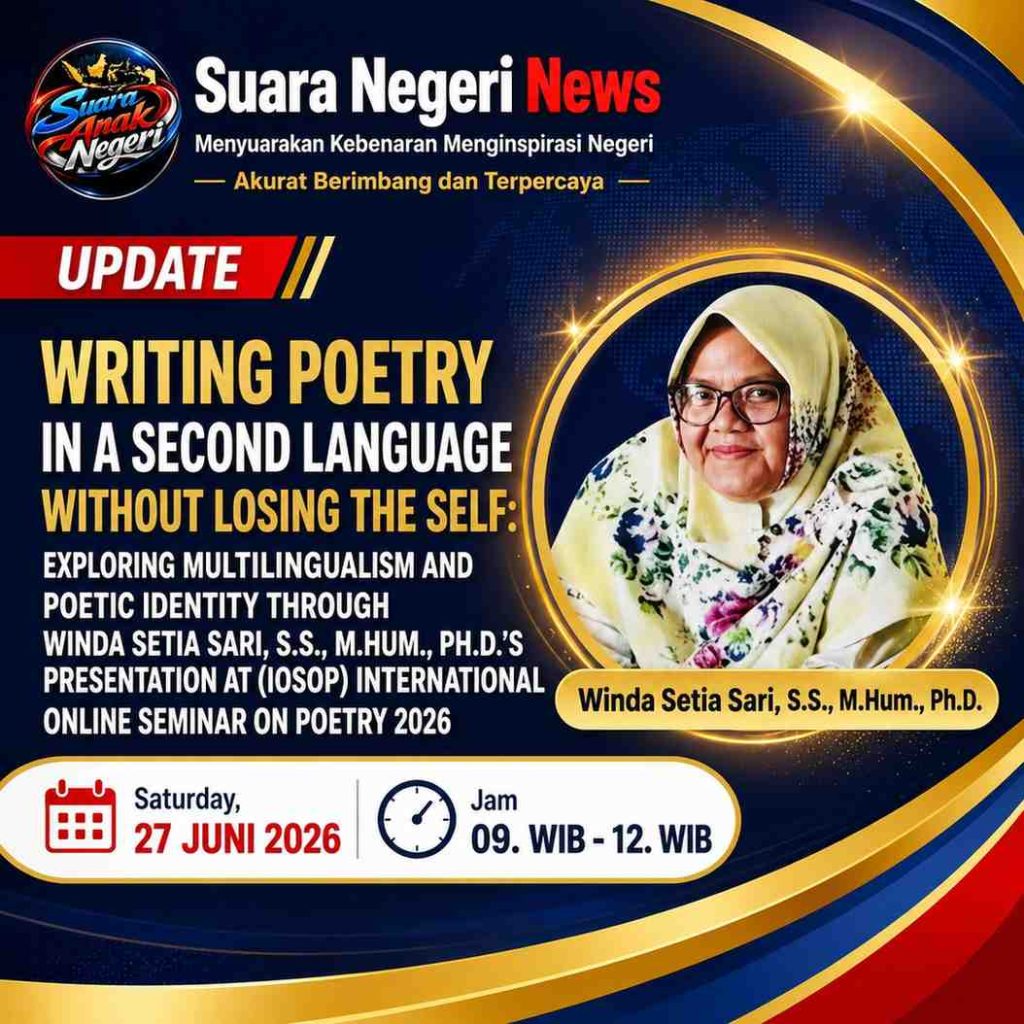
One of the most thought-provoking sessions at The Second International Online Seminar on Poetry (IOSoP) 2026 featured Winda Setia Sari, S.S., M.Hum., Ph.D., a lecturer at the State University of Medan (UNIMED) and the Head of the Master’s Program in Applied English Linguistics, Faculty of Languages and Arts, UNIMED in Medan. In her presentation, “Writing Poetry in a Second Language: Exploring Multilingualism and Poetic Identity,” she invited participants to enter the creative and intellectual journey of a poet who writes in a second language while remaining deeply rooted in her cultural identity.
Delivered in both Indonesian and English, the presentation went beyond reporting the findings of a practice-based research project. It unfolded as a deeply personal narrative of a Muslim Minangkabau woman seeking to discover her authentic poetic voice through English-language poetry. In Winda Setia Sari’s hands, poetry became far more than a creative endeavor; it emerged as a site of reflection, self-discovery, and identity negotiation amid the intersections of languages, cultures, and lived experiences.
Winda Setia Sari began her presentation by recalling a pivotal moment in 2017 when she first found the courage to publish her literary work in English.
“In 2017 I started to publish my first English writing.”
That decision eventually led her to pursue doctoral studies in the United Kingdom. It was during this academic journey that she came to realize that writing poetry in a second language was not merely a matter of grammar or word choice. Rather, it was a profound and ongoing process of understanding, constructing, and expressing one’s identity.
Writing in English once compelled her to question her position as a poet. In one of her reflections, she used the phrase “White mimic” to describe a lingering feeling that she was unconsciously imitating Western literary traditions.
This sense of unease gave rise to a fundamental question: does writing in a second language cause a poet to lose their cultural identity?
According to her, during the early stages of her writing journey, she had not yet fully discovered herself as an Asian woman, an Indonesian woman, and a Minangkabau woman within her English-language poetry. While a different language opened new avenues of expression, it also generated uncertainty about how her identity could be authentically represented in her work.
A significant turning point in her intellectual journey occurred while she was teaching poetry at the State University of Padang. One of her students posed a question that would remain with her for years.
“How could you write an English poem if you cannot sense and express your authentic inner feeling unless you wrote in your native language?”
The student then followed with another equally profound question:
“How can the reader recognize you through your poem if you don’t write your story in your language?”
These questions continued to resonate throughout her academic journey and ultimately became the foundation of her doctoral research.
Out of these personal and academic experiences emerged the central research question that guided her study:
“How can I develop my poetic identity by drawing on the multi-self attached to me as a woman, as a Muslim Minangkabau woman, daughter, wife, and mother in my second language writing?”
Through this inquiry, Winda Setia Sari sought to understand how her multiple identities, as a woman, a Muslim Minangkabau woman, a daughter, a wife, and a mother, could be authentically embodied in literary works written in a second language.
This exploration eventually evolved into a broader investigation of the relationship between multilingualism and second language writing identity.
One of the central arguments presented during the session was that using a second language does not automatically erase cultural identity. On the contrary, multilingualism can enrich artistic expression and expand a poet’s creative possibilities.
As she stated:
“Writing in a second language does not make you lose your identity.”
This assertion served as the central thread connecting her creative practice, academic inquiry, and personal reflections.
Winda Setia Sari’s doctoral study employed a Practice-Based Research approach, a methodology that places artistic creation at the heart of knowledge production.
For nearly four years, she engaged in writing poetry, reflecting on her creative processes, reading works by Asian poets, evaluating her own literary output, and connecting aesthetic experiences with scholarly inquiry. Through this process, poetry became not merely an object of study but also a means of generating new knowledge.
Her work demonstrates how artistic practice can function as a legitimate and rigorous form of research, producing insights that conventional methodologies may not always capture.
Perhaps the most important message conveyed in her presentation was that language is only a medium.
What ultimately shapes the identity of a poem is the lived experience, cultural heritage, religious values, family history, collective memory, and personal narratives embedded within it.
An Indonesian poet can remain authentically Indonesian while writing in English, provided that the cultural experiences shaping their worldview continue to inform and animate their work. Identity, therefore, is not determined by the language one uses, but by one’s awareness of the cultural roots and lived realities that nourish creative expression.
To conclude her presentation, Winda Setia Sari recited a short poem that encapsulated her intellectual and creative journey:
If my darling betrays,
I hide behind
the corpse
of my second language identity.
The poem serves as a powerful metaphor for the experience of a poet who once felt estranged within a second language, only to realize that authentic identity can never truly disappear. Languages may change, but memory, culture, and lived experience remain enduring foundations of the self.
Winda Setia Sari, S.S., M.Hum., Ph.D.’s presentation demonstrated that writing poetry in a second language is not an act of abandoning one’s mother tongue. Rather, it is an ongoing dialogue between language, culture, and identity.
Through her practice-based research, she illustrated how creativity and scholarly inquiry can work in tandem to generate new understandings of poetry, multilingualism, and selfhood. Her work challenges the assumption that linguistic transition necessarily entails cultural loss. Instead, it reveals how a second language can become a bridge through which local voices, traditions, and experiences reach global audiences.
For the poets, academics, students, and literary enthusiasts who attended IOSoP 2026, her presentation offered a compelling message for an increasingly interconnected world: multilingualism is not a threat to identity, but a powerful means of carrying one’s cultural roots into broader conversations across languages, borders, and literary traditions.